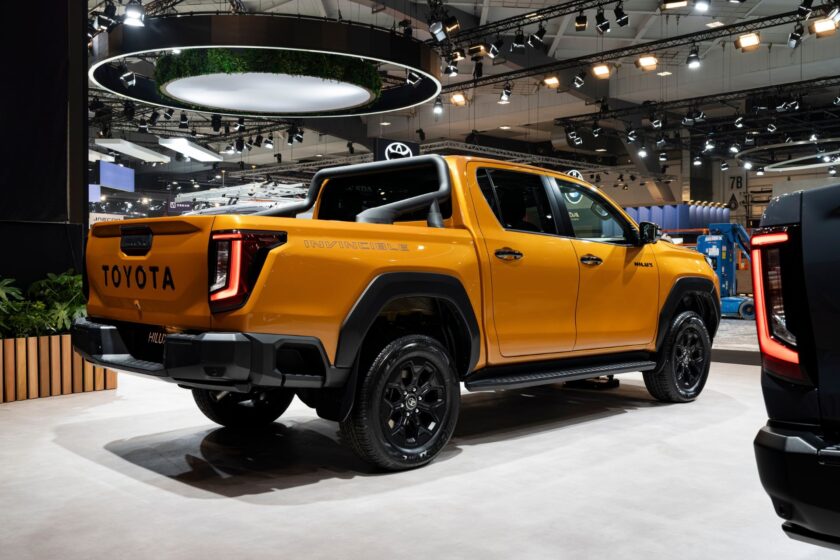
Presented in its European premiere at the Brussels Motor Show 2026, the ninth generation of Toyota Hilux marks a significant technical turning point in the history of the Japanese pickup, introducing for the first time a fully electric version alongside the 2.8-liter diesel equipped with a 48-volt hybrid system

The ninth generation of Toyota’s iconic pickup, the “Hilux,” made its debut at the Brussels Motor Show. For the European market, it will be offered in double-cab configuration, retaining the technical layout that has earned it global success with more than 27 million units sold worldwide.
The powertrain lineup, however, has been completely revised. The ninth generation expands the range by introducing a dual-electrification strategy designed to meet a wide variety of operational requirements. On one side is a 48-volt mild-hybrid powertrain, a pragmatic solution for users requiring high operational capability while also seeking improved fuel efficiency. On the other is a fully battery-electric version that delivers zero local emissions, addressing the needs of operators working in regulated urban environments, low-emission zones, or applications where quiet operation and the absence of exhaust emissions are priorities.
Both versions will be launched in Italy starting next April with the fully electric model, followed in July by the hybrid version.
From a technical standpoint, the “Hybrid 48V” version represents the evolution of Toyota’s well-known 2.8-liter four-cylinder turbodiesel engine, integrated with a 48-volt mild-hybrid system already introduced on the current generation.
The system consists of an electric motor-generator connected to the transmission via a belt drive and powered by a compact, lightweight lithium-ion battery. The electric unit assists during engine start-up and acceleration, providing additional torque during transient phases while helping to reduce the torsional vibrations typical of large-displacement diesel engines.
The result is smoother power delivery, reduced perceived noise levels, and lower fuel consumption and carbon dioxide emissions compared with the conventional diesel version.
The integration has been engineered without compromising operational capabilities. Payload remains at one tonne, while towing capacity reaches 3.5 tonnes, benchmark figures for the segment.
The positioning of the electrical components has been carefully designed to preserve approach and departure angles, chassis rigidity, and water-fording capability, which remains unchanged at 700 millimeters.
The “Multi-Terrain Select” system, combined with the “Multi-Terrain Monitor” and “Panoramic View Monitor,” adjusts engine response, braking, and traction control according to surface conditions, optimizing torque distribution across all four wheels.
The most significant innovation, however, is the “Hilux BEV,” the first fully electric version of the model.
The system employs a lithium-ion battery with a capacity of just under 60 kWh, coupled with two electrified axles—one front and one rear—to provide permanent all-wheel drive without any mechanical connection between the axles.
The front axle delivers 205 Nm of torque, while the rear axle produces 268 Nm. Independent electronic management allows instant torque distribution according to available traction.
Official WLTP range reaches 257 kilometers in the combined cycle and up to 380 kilometers in urban driving. These figures are consistent with a vehicle intended primarily for professional use.
Payload capacity stands at 715 kilograms, while towing capacity reaches 1,600 kilograms. Although lower than those of the diesel version, these figures remain significant for an electric pickup built around a traditional body-on-frame architecture.
From an engineering perspective, the electric powertrain has been integrated into a conventional body-on-frame chassis. The battery has been positioned to ensure structural protection, optimal weight distribution, and the preservation of ground clearance, which remains at 212 millimeters.
Water-fording capability also remains unchanged at 700 millimeters, a noteworthy achievement considering the presence of high-voltage components.
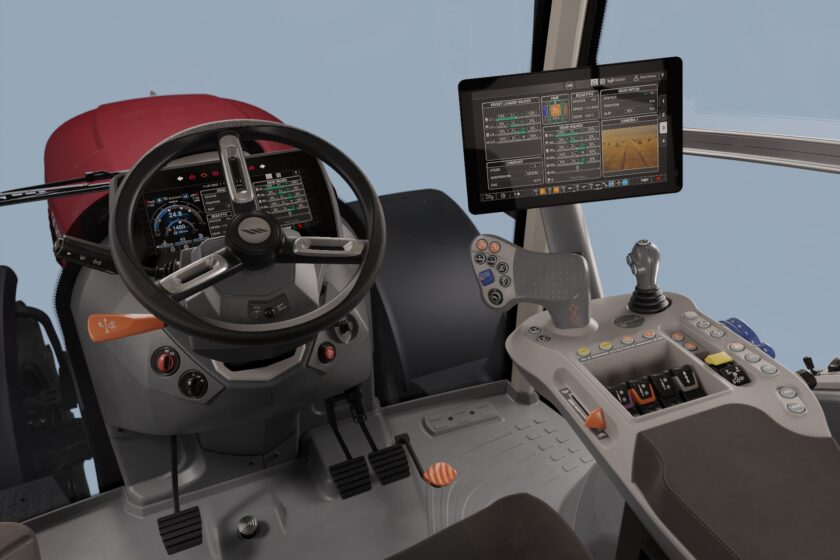
The adoption of electric power steering, now standard across the entire range, improves steering precision and modulation, while the shift-by-wire transmission control system eliminates traditional mechanical linkages, enabling smoother selection of driving modes.
For the electric variant, Toyota has developed a dedicated “Multi-Terrain Select” system capable of managing torque delivery and regenerative braking at each individual wheel. By exploiting the rapid response of the electric motors, the system ensures optimal traction even on low-grip surfaces.
Title: Toyota Hilux: electrification to the ninth power
Translation with ChatGPT