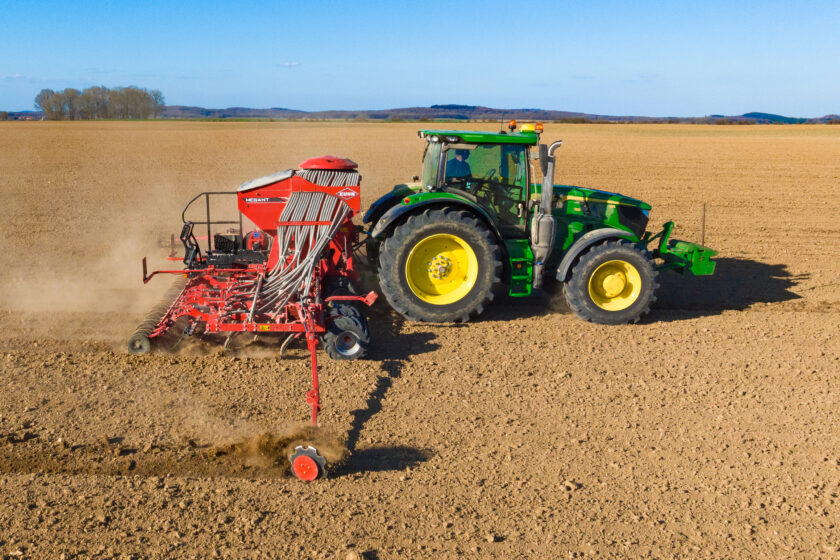
Espro (trailed) and Megant (mounted) seeders by Kuhn are designed for minimum tillage practice, boosting both farm profitability and soil health
Those preparing to sow wheat—whether soft or durum—must now take into account several economic factors, starting with the fact that the days of €550 per ton, paid in 2022 following the outbreak of the war in Ukraine, are long gone. At the end of the 2025 harvest, prices were fluctuating between €270 and €290 per ton, respectively for top-quality soft and durum wheat.
On the other hand, CAP’s Eco-Scheme 4 offers €64.33 per hectare, a 23% increase over 2023. In nitrate-vulnerable zones (NVZs) and Natura 2000 areas, this amount has been further raised—from €62.54 to €77.20 per hectare—if minimum tillage practices are adopted. This is particularly relevant since NVZs account for over 80% of the UAA (utilized agricultural area) in Lombardy, Friuli, and Veneto; 60% in Emilia-Romagna; and 24%, 23%, and 14% in the Marche, Umbria, and Tuscany regions respectively.
These figures show how minimum tillage can have a significant impact on farm budgets, especially for larger agricultural enterprises. To meet the requirements for subsidies—and with the wheat sowing season just weeks away—those still looking for the right equipment can turn to Kuhn, and in particular to its single-hopper seed drill series: the Espro (trailed, disc-type) and the Megant (mounted, tine-type).
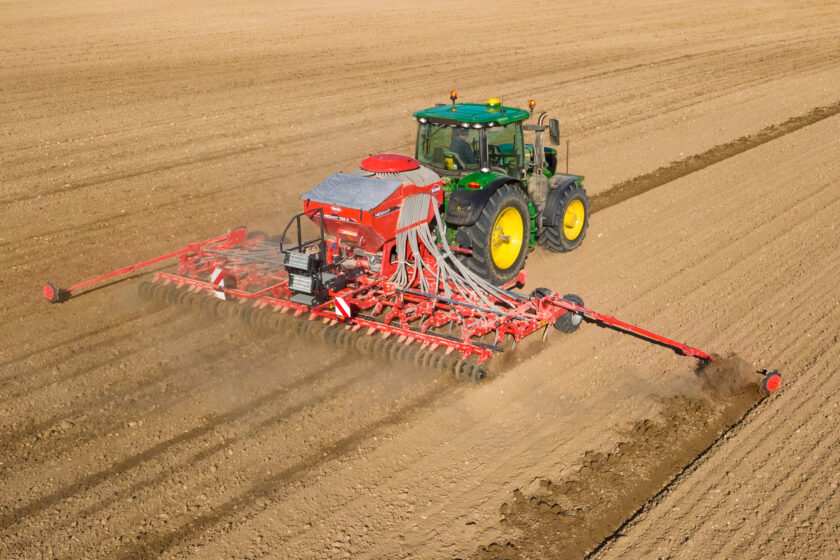
The Espro range has recently evolved from the Espro 1000 R to the new Espro 1002 R series, which includes three models: 3002, 4002 R, and 6002 R.
- The 3002 features a rigid frame with a 3-meter working width,
- while the 4002 R and 6002 R offer 4- and 6-meter widths, respectively, with folding frames for easier road transport.
Hopper capacities also vary: 2,500 liters on the 3002, and 3,500 liters on both the 4002 R and 6002 R.
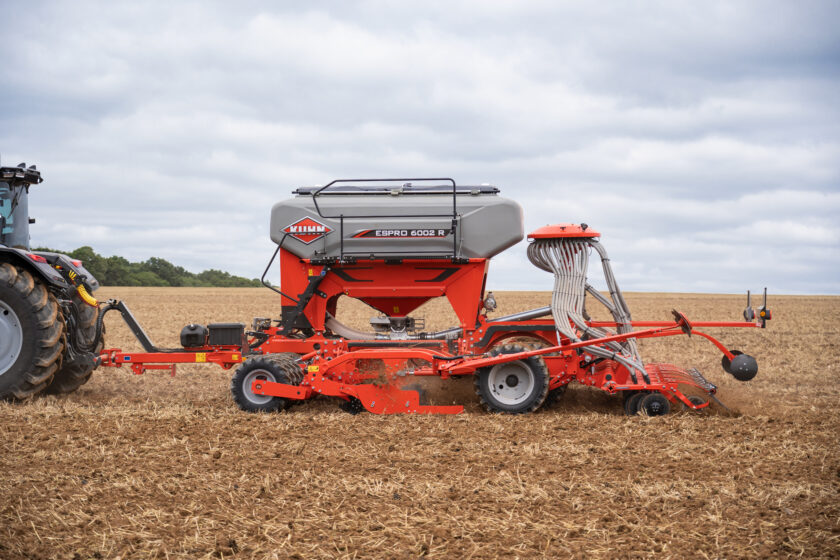
All models deliver high in-field productivity, thanks to a six-stage operational system that:
- Levels the soil surface,
- Performs final soil preparation and compaction,
- Carries out precise seed placement,
- Follows with row-by-row pressing and covering.
This sequence makes Espro drills suitable not only for minimum tillage but also for use after traditional ploughing, without compromising sowing precision—either in depth or seed spacing.

Central to this performance is the Crossflex bar, featuring a cross-shaped profile and double-disc coulters held in position by polyurethane bushings. This design maximizes stability even at high working speeds.
Other noteworthy features include:
- Low power requirement, due to reduced friction from the 900 mm narrow-profile press wheels,
- 200 mm row spacing, facilitating smooth rolling and efficient work even in the presence of crop residues.
For Those Who Prefer Mounted Models
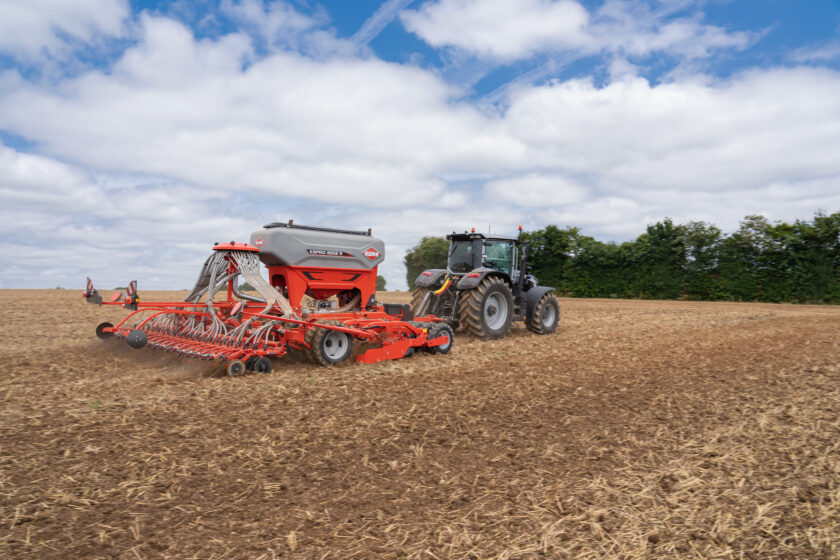
The Megant series, which is mounted, also focuses on minimum tillage, and has recently been expanded with two new models: the 722 R and 802 R, both equipped with folding frames for working widths of 7.2 and 8 meters respectively. This extension complements the existing 6-meter version, broadening the range’s capabilities.
Designed to work effectively under varied field conditions, Megant drills perform shallow soil cultivation using a choice of three tine types—reversible, straight, or 12 mm narrow tines—ensuring effective penetration in all soil types and zero maintenance.
The tines, uniformly distributed across four rows, provide ample clearance for the passage of crop residues and stones.
In-field autonomy is also excellent, thanks to the 1,800-liter hopper, which can be expanded with the optional SH 1120 front hopper (+110 liters). This option allows operators to sow two seed varieties simultaneously or to apply granular fertilizer in a single pass.
Power requirements are 180 HP for the 722 R and 200 HP for the 802 R.
Title: Espro and Megant seeders by Kuhn: produce more with less work
Translation with ChatGPT