Sensitive to the challenges posed by an aging population and the shortage of skilled labor, Kubota used Agritechnica 2025 as a stage to showcase its latest Smart Farming solutions

“Smart Farming,” or “intelligent agriculture,” is an expression that encompasses two core objectives: enhancing the economic profitability of farms while at the same time making them increasingly sustainable from an environmental standpoint. According to Kubota, the automation of agricultural practices will be one of the key factors in addressing these needs.
On the strength of this belief, the company has been steering the work of its research centers accordingly, dedicating a specific area within its Hanover stand to allow visitors to experience firsthand the solutions developed so far—aimed at creating agricultural machines capable of operating autonomously, without direct human control.
Among the most striking examples were three solutions, one of which—the “KATR” platform—stood out for the sheer breadth of its operational possibilities. This is a compact, four-wheeled robot designed to provide a stabilized platform even when moving on steep slopes or rough terrain.
This objective is achieved through four articulated legs that follow the ground’s contours. The movement of KATR is governed by an inertial platform that ensures the platform remains constantly level, a set of sensors that detects the presence of obstacles, and a GPS system that defines trajectories with centimeter-level precision.
In its current configuration, KATR can transport up to 240 kilograms of payload over uneven ground without product losses, but there is nothing to prevent it from serving in the future as an operational platform to support various implements. In effect, it is a multifunctional system whose advantages also include the ability to be transported on the back of a minivan or pickup truck and to operate 24 hours a day, aside from the stops required for maintenance and refueling.
At present, refueling is carried out in the traditional way, with diesel, but in the future it could be based on battery recharging should the internal combustion engine be replaced by electric units.
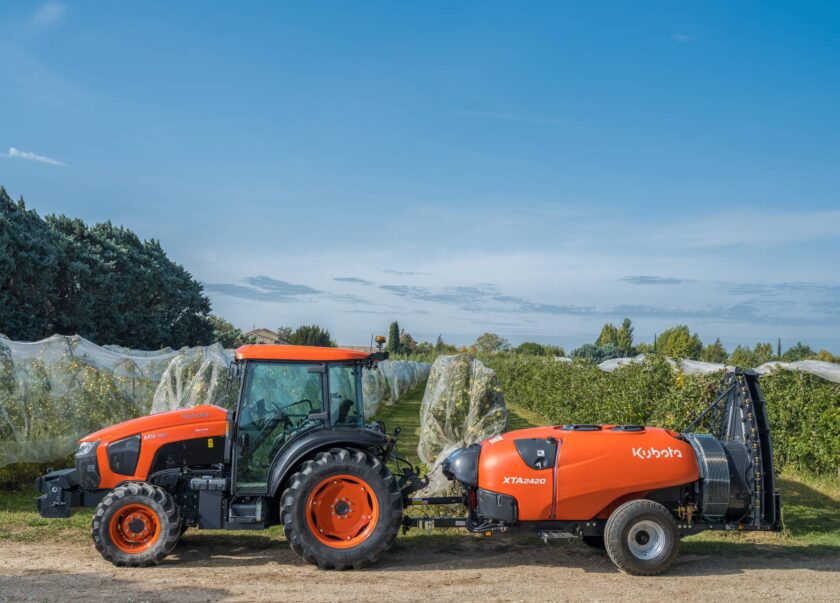
A similar approach applies to “KFAST,” a self-propelled sprayer capable of carrying out crop protection treatments fully autonomously or via remote control. This is a specialized robot, guided by an artificial intelligence system that, through dedicated detection cameras, can move deftly between rows, identifying and avoiding any obstacles along its path.
The AI also detects the shape and size of the plants, adjusting spray volumes in real time. Among its capabilities is the ability to return to base whenever it detects that the tank is empty or that it has run out of fuel.
Also on display at the stand was an autonomous version of a traditional “M7004” series tractor, suitably equipped with a set of sensors enabling completely driverless operation in the field, with no operator on board.
Title: Solutions Smart Farming by Kubota: under the banner of automation
Translation with ChatGPT