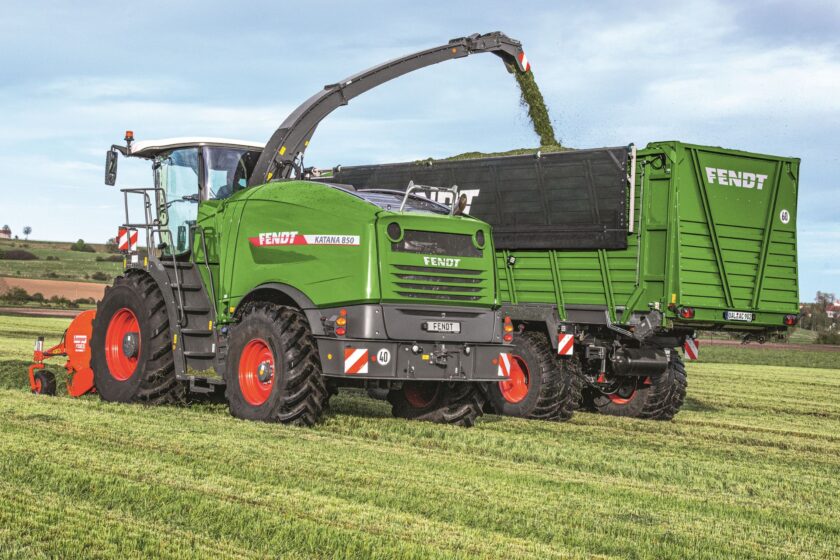
The Fendt Katana self-propelled forage harvesters were launched in 2011 and have since undergone a continuous process of refinement that has resulted in today’s two-model range, combining maximum field productivity with equally outstanding forage quality
Over the past decade, every manufacturer of self-propelled forage harvesters has continuously upgraded its machines to meet the growing demand generated by the expansion of biogas plants in major maize-growing regions. Traditional livestock feeding requirements have been joined by those of the renewable energy sector, leading to longer harvesting campaigns and a growing need for shorter chop lengths to improve biogas yields.
As a result, advances in engine power and digital technologies designed to optimise machine performance have also driven dramatic increases in hourly productivity. Since the 1970s, maximum output has increased almost fivefold, from approximately 75 to around 400 tonnes of crop per hour.
Alongside these developments, both the number of available models and the number of manufacturers have increased. One of the latest entrants is Fendt, which introduced its first self-propelled forage harvester, the Katana 65, at Agritechnica in November 2011.
Remaining true to its engineering philosophy, Fendt launched a machine packed with advanced technology and has continued to refine it over the years, resulting in today’s Katana range, consisting of the Katana 650 and Katana 850.
Rated at 650 and 847 hp respectively, both models feature the Fendt CropFlow 2.0 crop processing system, which manages the entire crop flow from the six feed rollers to the discharge spout. The 770 mm-wide feed rollers, driven by a continuously variable hydrostatic transmission, compress the crop before feeding it into a 720 mm chopping drum, currently the largest available on the market.
Operating at 1,150 rpm and equipped with 28 V-arranged knives, the drum performs up to 16,100 cuts per minute. Chop length can be adjusted continuously from the cab, ranging from approximately 2.5 mm to more than 42 mm depending on the drum configuration and the number of knives installed.
This enables operators to respond instantly to the different requirements of the market, from the longer chop lengths preferred for livestock feed to the extremely short cut required by many biogas plants.
A six-stage adjustable metal detector protects the chopping drum from foreign objects while ensuring consistently high forage quality before the material passes through one of two available kernel processors: the R-Cracker or the Rs-Cracker.
Both systems feature twin 300 mm-diameter rollers with hardened, chrome-plated surfaces, but differ in their tooth profiles, making them suitable for different applications. The R-Cracker uses rollers with 148 serrated teeth operating at a speed differential of between 30 and 40 percent, making it ideal for conventional chop lengths of up to approximately 20 mm.
The Rs-Cracker, by contrast, features spiral V-shaped teeth that provide more aggressive kernel processing in both the longitudinal and transverse directions.
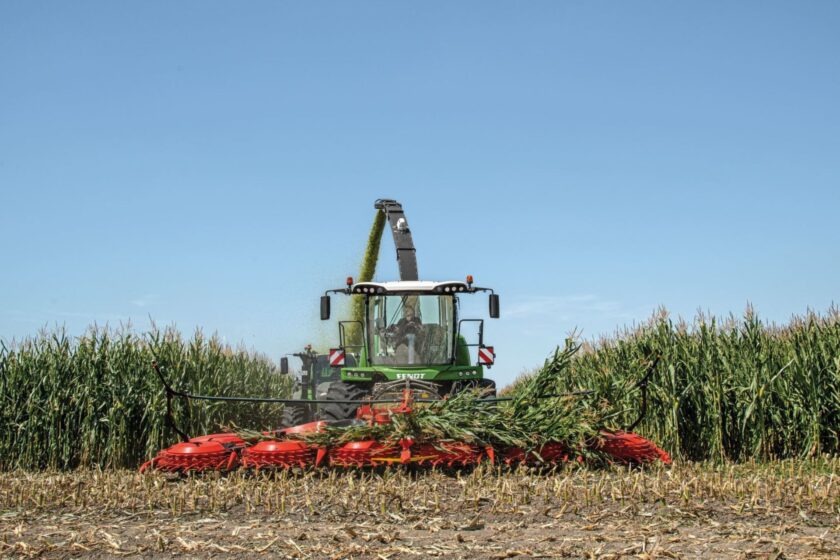
Both kernel processors can be disengaged whenever their action is unnecessary. In all cases, the processed crop is discharged through a spout offering a 210-degree swivel angle and a discharge height exceeding six metres. The spout also incorporates the Fill Control function, which automatically adjusts the position of the final spout section according to trailer position, distributing the crop evenly without operator intervention.
Power comes from two German-built inline six-cylinder engines.
The Katana 650 is equipped with an MTU 6R 1500 engine with a displacement of 15.6 litres, delivering the 650 hp reflected in the model designation at 1,600 rpm, together with a maximum torque of 3,100 Nm at 1,300 rpm.
The engine features Turbo Compound technology, which recovers energy from the exhaust gases to provide additional power without increasing fuel consumption. Stage V compliance is achieved through exhaust gas recirculation, a diesel particulate filter and SCR after-treatment.
The Katana 850, meanwhile, is powered by an 18-litre Liebherr D976 engine producing 847 hp at 1,900 rpm and a maximum torque of 3,651 Nm at 1,300 rpm. In this case, Stage V compliance is achieved using SCR technology alone, without the need for a particulate filter.
Both engines share a reversible cooling fan with pneumatically adjustable blades whose pitch can vary between 5 and 38 degrees, reducing power consumption by up to approximately 27 hp compared with conventional fans delivering the same airflow.
An Eco operating mode is also available, allowing engine speed to be reduced without affecting chopping performance whenever crop conditions require less power.
Traction is managed by the Fendt BalancedGrip all-wheel-drive system, which uses a gyroscope to detect weight transfer caused by slopes and automatically redistributes torque between the front wheels and rear axle. This minimises wheel slip while maintaining traction even in the most demanding conditions.
The system is particularly beneficial for operators working in hilly terrain and can be activated or deactivated directly from the in-cab terminal.
Fendt has invested heavily in operator comfort, designing a cab that meets the high standards expected by its customers. Fully climate-controlled, completely isolated from mechanical vibrations and equipped with an air-suspended driver’s seat, the cab also features specially designed front glazing and a rear window incorporating sound-absorbing films that reduce perceived noise levels by approximately 3 dB—a significant improvement for a machine designed to operate for long hours under extreme conditions.
A VarioTerminal display with a screen larger than 10 inches, operated either via touchscreen or physical controls, allows all machine functions to be monitored and programmed. The terminal integrates with an ergonomic armrest featuring the multifunction joystick familiar from Fendt tractors.
Among its controls are three freely programmable buttons, one of which can be assigned to activate the VarioGuide automatic steering system. When combined with the Contour Assistant module, VarioGuide can automatically steer the machine along curved headland boundaries and follow previously recorded tractor guidance lines in single-track mode, a particularly valuable feature when the forage harvester and transport vehicles are working together on the same harvesting operation.
Forage Quality Always Under Control
Among the latest innovations introduced by Fendt on the Katana range is the ForageQualityCam system, which received a Silver Medal at Agritechnica 2025.
The system consists of a high-speed camera that captures 13 images per second of the crop stream immediately after the kernel processor and transmits them to a dedicated processing unit installed in the cab.
A dedicated algorithm analyses kernel breakage in real time and displays the results on a dedicated monitor together with the CSPS (Corn Silage Processing Score) value.
Studies have shown that a CSPS value of 70 percent or higher has a positive effect on milk production, as it indicates well-processed forage that is more easily digested by livestock.
Until now, determining this parameter required manual sampling followed by laboratory analysis, with results only becoming available several days later. During that time, the forage harvester could continue operating with sub-optimal kernel processor settings without anyone being aware of the issue.
With ForageQualityCam, monitoring is continuous and carried out in real time. Whenever the measured value falls below the threshold set by the operator, the system immediately generates an alert, allowing the kernel processor settings to be adjusted without delay.
The benefits are significant for both farmers and contractors. Farmers achieve higher silage quality and improved livestock productivity, while contractors can demonstrate forage processing quality to customers in real time during harvesting.
To ensure even more comprehensive crop quality monitoring, ForageQualityCam operates alongside an NIR sensor that continuously measures the crop’s nutritional characteristics, as well as an automatic chop-length adjustment system that adapts cutting length according to dry matter content. This helps achieve better silage compaction whenever the harvested crop is drier than expected.
Title: Fendt Katana: 15 years of continuous Refinement
Translation with ChatGPT