Kuhn has expanded its range of belt and rotary rakes with new models in the Kuhn Merge Maxx and Ga series. Greater efficiency and higher forage quality provide significant benefits for harvesting machines
When a baler, whether round or square, is collecting forage, it performs best when working on windrows that have been formed correctly in terms of shape, density, and cleanliness. There are two main technical approaches to achieving this: belt mergers and the more traditional rotary rakes. In both cases, the equipment must be capable of lifting and moving forage from the ground and placing it into uniform, well-formed windrows without compromising working speed. After all, time is money.
With this objective in mind, Kuhn has recently expanded both its “Merge Maxx” belt merger range and its “GA” rotary rake lineup.
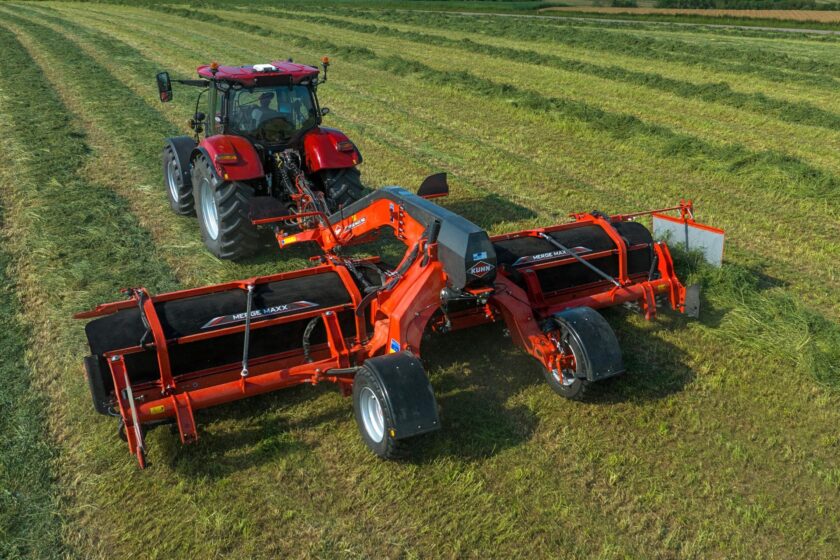
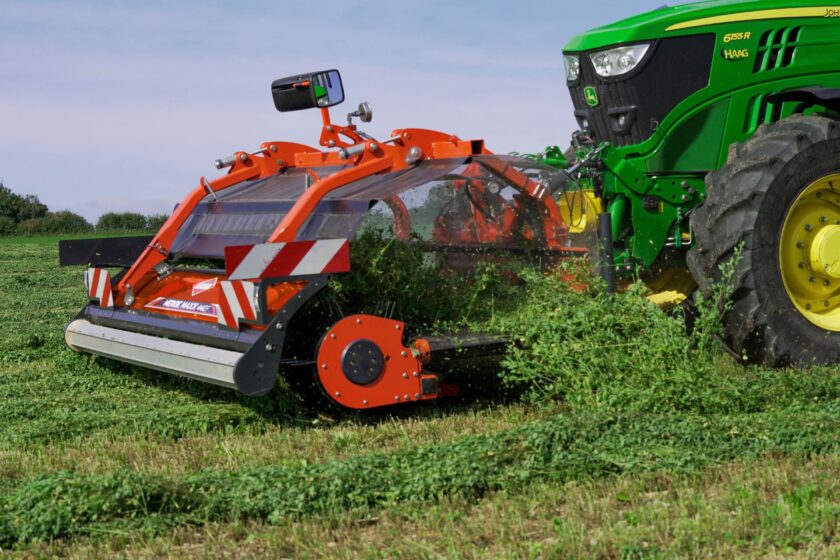
The “Merge Maxx” series consists of five models, starting with the front-mounted “Merge Maxx 442 F”, a three-meter-wide machine designed to maximize forage quality by moving the crop sideways before the tractor wheels pass over it. This is achieved through a dual-belt system unique within the sector, which deposits equal amounts of forage on both sides.
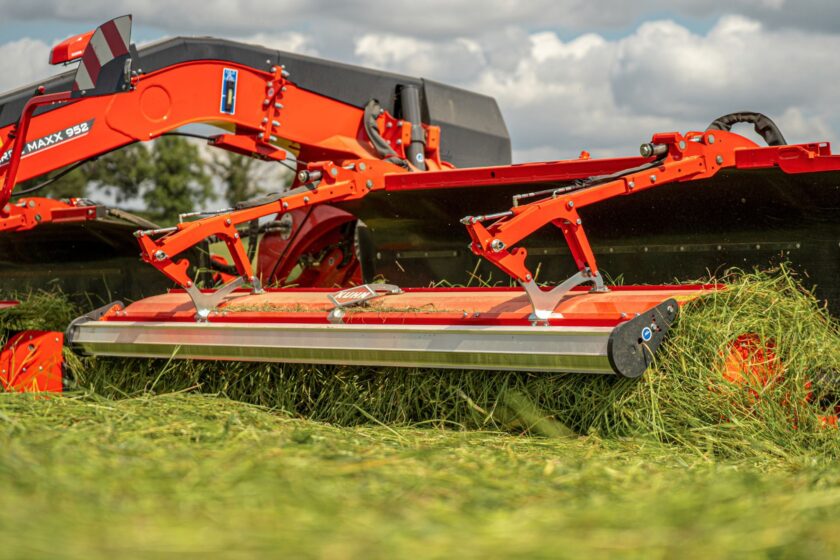
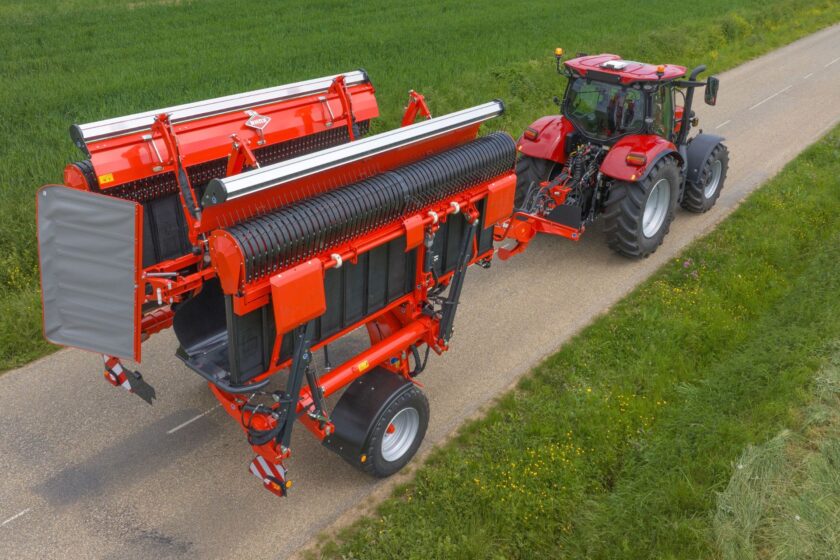
The range is completed by four trailed “Merge Maxx” models with working widths ranging from 5.5 to 10.95 meters. The entry-level trailed version, the “Merge Maxx 762”, is offered without ISOBUS capability and can operate across working widths from 5.5 to 7.5 meters. This solution is particularly suited to small and medium-sized farms, both in terms of acreage and investment capacity.
The intermediate model, the “Merge Maxx 952”, is available in both standard and ISOBUS versions. The latter reduces operator workload and offers enhanced functionality. The “Merge Maxx 1092”, capable of operating on working widths between 8.85 and 10.95 meters, is available exclusively with ISOBUS control.
On ISOBUS-equipped models, all adjustments are controlled directly from the cab through optional “CCI 60”, “CCI 800”, or “CCI 1200” terminals. These allow operators to manage a wide range of functions, including windrow placement modes, working height, dynamic suspension relief of the operating units, and the position of the “Windguard” roller, designed to minimize crop losses during operation.
The menus and display screens are intuitive and easy to manage, allowing rapid adaptation to changing field conditions. Operators can quickly adjust conveyor belt and pickup speeds and pressures, ensuring optimal performance on all types of terrain while preserving the crop stubble and ground cover.
Furthermore, when operating in side-delivery mode, the conveyor belt closest to the windrow—handling the largest volume of forage—is able to run faster than the outer belt. This prevents forage accumulation inside the machine channel and eliminates the risk of blockages.
Two and Two Make Four
Kuhn’s rotary rake range also introduces new solutions designed to combine high productivity with excellent forage quality. Two models deserve particular attention: the “GA 7631 P” and the “GA 14231”.
The mounted “GA 7631 P” features two rotors for forming central windrows and represents an excellent compromise between productivity and compact dimensions. With a maximum working width of 7.40 meters, the machine comes standard with hydraulic adjustment of the working width and produces windrows ranging from 1.30 to 2.20 meters in width.
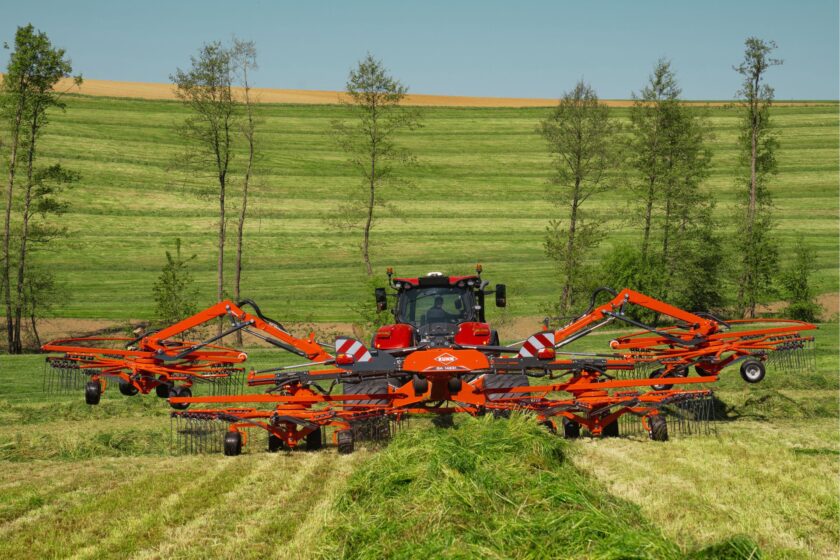
The trailed four-rotor “GA 14231” completes the French manufacturer’s hay and forage equipment range with a maximum working width of 13.70 meters. It is therefore aimed at large-scale farming operations and professional contractors, standing out for its high productivity and low maintenance requirements.
A key contributor to these characteristics is the hydraulic drive system, which requires virtually no maintenance and is capable of handling even heavy forage crops with ease.
Title: Kuhn expands its range of belt and rotary rakes with Kuhn Merge Maxx and Ga
Translation with ChatGPT